
For years, one of the most common messages in entrepreneurship has been simple: grow. Grow your team, grow your office, grow your revenue, and scale your business.
But what if bigger isn’t actually the goal?
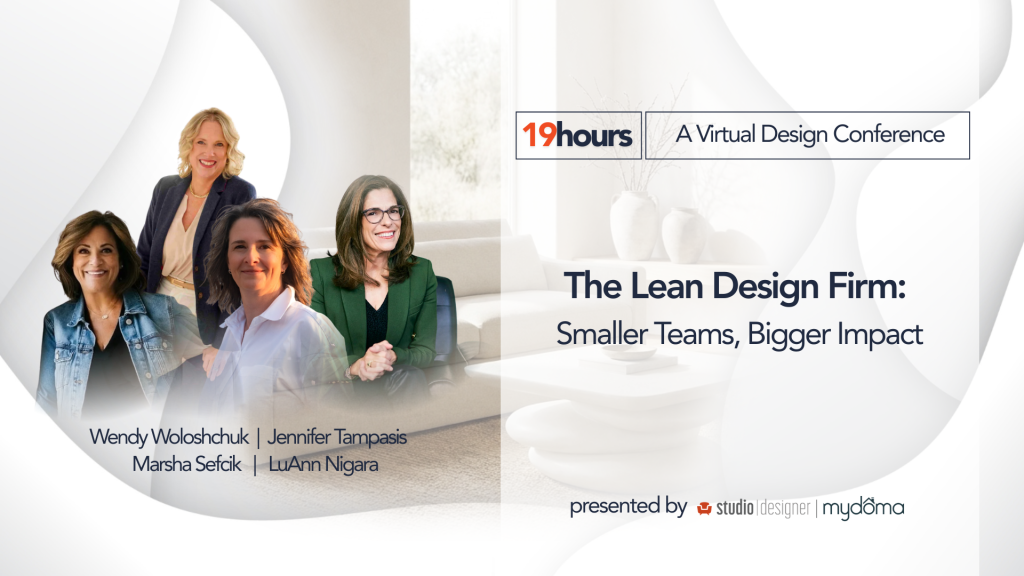
At Studio Designer’s 19 Hours Virtual Design Conference, business expert and podcast host LuAnn Nigara sat down with three successful design professionals—Wendy Woloshchuk of Details Interiors, Jennifer Tampasis of Jennifer Lynn Interiors, and designer and business consultant Marsha Sefcik—to discuss a different path. Their businesses look different on paper, but they share a common belief: success isn’t defined by headcount. It’s defined by profitability, sustainability, and creating a business that supports the life you want to live.
Challenging the “Bigger Is Better” Mindset
Many designers feel pressure to scale because it’s often the version of success they see celebrated. Larger teams, larger offices, and larger revenues can make it seem like growth is the natural next step.
For Wendy Woloshchuk, that pressure led to an important realization. After listening to countless conversations about scaling, she began questioning whether she should want those things too. Ultimately, she realized she didn’t. What she wanted was a successful business with low overhead, flexibility, and balance.
Jennifer Tampasis learned a similar lesson through experience. During the surge in demand during the pandemic, she expanded her team to keep up with incoming work. Instead of feeling more successful, she found herself spending more time managing employees and less time doing the creative work she loved. Eventually, she intentionally rebuilt a leaner structure that better aligned with her strengths and goals.
For Marsha Sefcik, the decision was intentional from the start. While homeschooling two children and building a design business, she quickly learned that growth had to fit the life she was actually living. As her capacity changed, her business evolved, but her philosophy remained the same: growth should be intentional, not automatic.
The panelists weren’t arguing against growth. They were challenging the assumption that growth always means getting bigger.
Small Doesn’t Mean Casual
One of the biggest misconceptions about solo and lean firms is that they operate with less structure. In reality, the panelists argued the opposite.
Without layers of management or built-in accountability, business owners must create their own systems to stay productive and profitable.
Jennifer relies on documented processes, clear boundaries, and structured planning. Wendy uses time blocking and dedicated days for specific activities. Marsha starts every week with a dedicated CEO date focused on marketing, business development, and planning.
The common thread wasn’t the specific system—it was the commitment to treating the business like a business.
As LuAnn pointed out during the discussion, the difference between a business and a hobby often comes down to discipline. Successful lean firms don’t happen by accident. They are built through consistent routines, clear expectations, and intentional decision-making.
Know Your Numbers
If there was one topic every panelist agreed on, it was the importance of understanding financial performance.
Marsha schedules “Financial Fridays” every week to review revenue, expenses, profitability, and overall business health. Wendy and Jennifer emphasized the importance of setting financial goals and regularly measuring progress against them.
Knowing your numbers isn’t just about accounting. It’s about understanding whether your business model is working.
The panelists discussed everything from owner compensation to profitability benchmarks, reinforcing a simple truth: revenue alone doesn’t determine success. A lean business with strong margins and low overhead can often create more financial freedom than a much larger operation with higher expenses.
For designers who want to stay small, financial visibility is what makes that decision sustainable.
Building a Business That Works for You
One of the most interesting themes to emerge from the conversation was that many designers aren’t necessarily looking for more growth. They’re looking for more freedom.
For some, that means creating a predictable pipeline of work. For others, it’s attracting better-fit clients, improving profitability, or building a business that allows for greater flexibility.
The panelists emphasized that achieving those goals starts with clarity. Understanding your ideal client, refining your marketing message, and nurturing relationships with vendors, contractors, architects, and past clients can often have a greater impact on business success than simply adding more employees.
Interior design remains a relationship-driven industry. Great client experiences generate referrals. Strong vendor relationships create opportunities. And consistent marketing helps ensure the right projects continue to come through the door.
For many successful lean firms, those fundamentals matter far more than team size.
Defining Success on Your Own Terms
The conversation ultimately returned to a simple but powerful idea: there is no single blueprint for success.
Some designers will build large firms with extensive teams and multiple locations. Others will intentionally remain small, maintaining low overhead and greater flexibility. Both approaches can be profitable, rewarding, and sustainable.
The key is understanding what you want your business to provide—not just financially, but personally and professionally.
For Wendy Woloshchuk, Jennifer Tampasis, and Marsha Sefcik, success wasn’t measured by the number of employees on payroll. It was measured by their ability to build businesses that support their goals, serve their clients well, and create lives they genuinely enjoy living.
Watch the Full Webinar On Demand
Want to hear the full conversation?
Watch the complete session from Studio Designer’s 19 Hours Virtual Design Conference to hear additional insights from LuAnn Nigara, Wendy Woloshchuk, Jennifer Tampasis, and Marsha Sefcik on profitability, accountability, marketing, systems, and building a design business that works for you—not the other way around.
Join our newsletter
Get the latest in interior design trends, expert tips, and exclusive project insights delivered straight to your inbox!